
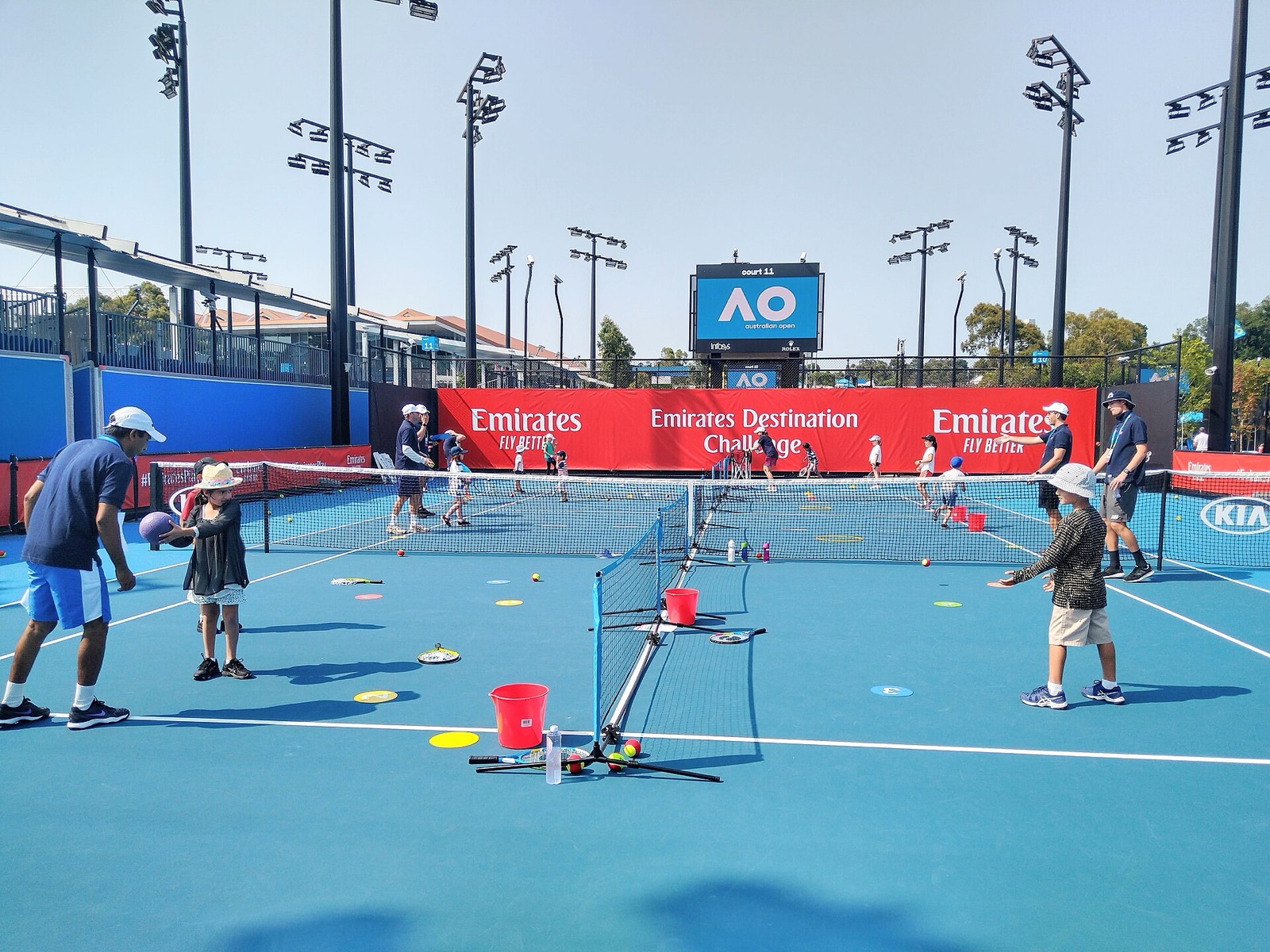
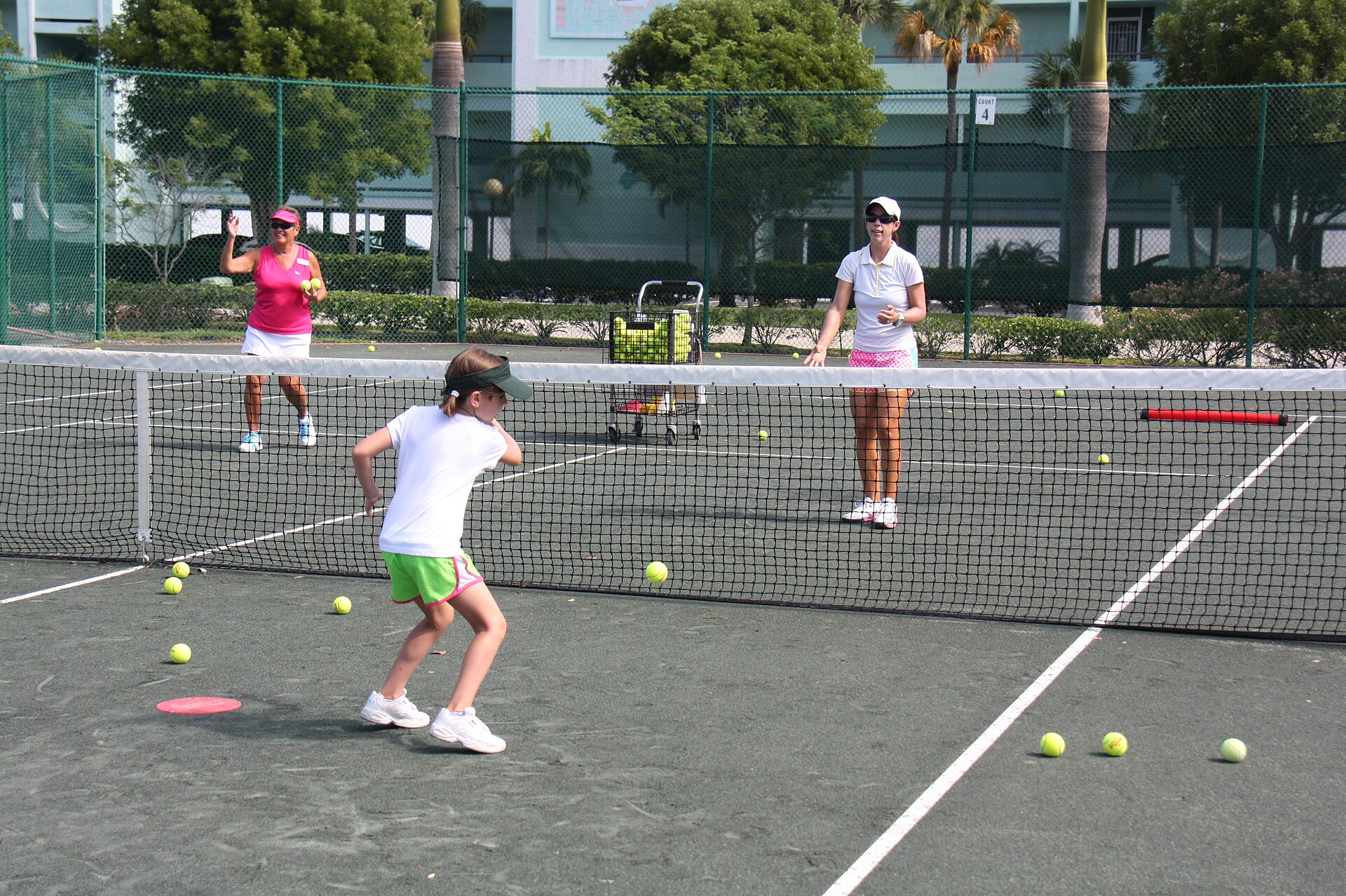

Set up the practice lane
Mark a rectangle about six adult paces long and four paces wide on a dry, level surface. Put a two-pace target gate at one end and a tape line across the middle. Use one racket and one red or other low-compression ball suited to the player's current control. Leave a clear racket-length plus one adult step around the hitter, with nobody waiting beside or behind the swing.
Run the session
Tap once and catch
Stand in the middle with the racket face level and in front. Place the ball on the strings, tap it up below eye height, and catch it with the free hand after one bounce on the strings. Make five calm catches, rest, then repeat. If the ball flies away twice, return to balancing it for three seconds before each tap.
Keep the racket face in front, make one small tap, then catch. Both feet stay planted while the ball rises below eye height.
Drop, bounce, and send through the gate
Stand three adult paces from the wide target gate. Hold the ball in the free hand, drop it slightly in front and to the racket side, let it bounce once, then use a short swing to send it along the ground or at knee height through the gate. Reset after every shot. Count five contacts that stay inside the clear rectangle, not five perfect targets.
Drop the ball in front of the racket side, let it bounce once, and use a short send through the wide gate. The marked circle shows the contact area.
Feed, return, and catch
The adult stands beyond the tape line and underarm-feeds a gentle ball to bounce in front of the child. The child sends it back; the adult catches after one bounce. Start again from the same spots. Try to complete three catchable returns in the five-minute block. Move closer or feed more slowly before changing the swing.
The adult underarm-feeds across the tape line. The child lets the ball bounce, sends it back, and the adult catches after one bounce.
Choose the version that fits the setup
With an adult feeder
Run all three blocks as written. The adult's job is a repeatable underarm feed, not coaching during the swing.
One child practising alone
Repeat the tap-and-catch block, then self-feed through the gate from two distances. Replace the final block with ten self-feeds, resetting after every ball.
Very small safe space
Use a foam or red ball, shorten the gate distance, and keep every send below waist height. Do not use a wall until the rebound path and surrounding property are safe.
What success looks like
- The child can make five single taps and catches without leaving the marked rectangle.
- The self-feed bounces in front of the racket side instead of behind the feet.
- At least three returns reach the adult slowly enough to catch after one bounce.
Make it easier
Remove the racket for one minute and practise drop, bounce, and two-hand catch. Then balance the ball on the strings without tapping. In the sending blocks, move the gate closer and let the adult feed from the same side every time.
Make it harder
Keep the same slower ball and make one change: narrow the target gate, ask the child to recover behind the centre marker, or count two cooperative returns before the adult catches. Do not add all three at once.
Safety
Check the surface for water, gravel, toys, and loose balls before each block. Keep other people outside the swing area and stop the activity before collecting a missed ball. Do not practise toward roads, windows, parked cars, or occupied paths. Stop if the child reports pain, dizziness, or cannot control the racket safely.
Common questions
What tennis ball should a child beginner use?
Use a slower ball the child can control. The LTA lists red for ages 8 and under, orange for 8-9, and green for 9-10 as starting points. Local competition rules may differ, and a new starter may need the slower option before moving on.
Can a child start tennis without a court?
Yes. Ball balancing, tap-and-catch work, self-feeds, and cooperative returns can use a small marked area. The surface still needs to be level, dry, away from traffic and glass, and wide enough for the full racket swing.
Should a beginner practise a full forehand straight away?
Start with a drop, one bounce, and a short send toward a wide target. That lets the child find the bounce and contact area before adding a larger swing, movement, or faster feed.
Does this session replace a tennis lesson?
No. It is a short first practice for control and cooperative contact. A qualified local coach can assess grip, racket fit, movement, and technique in person.