
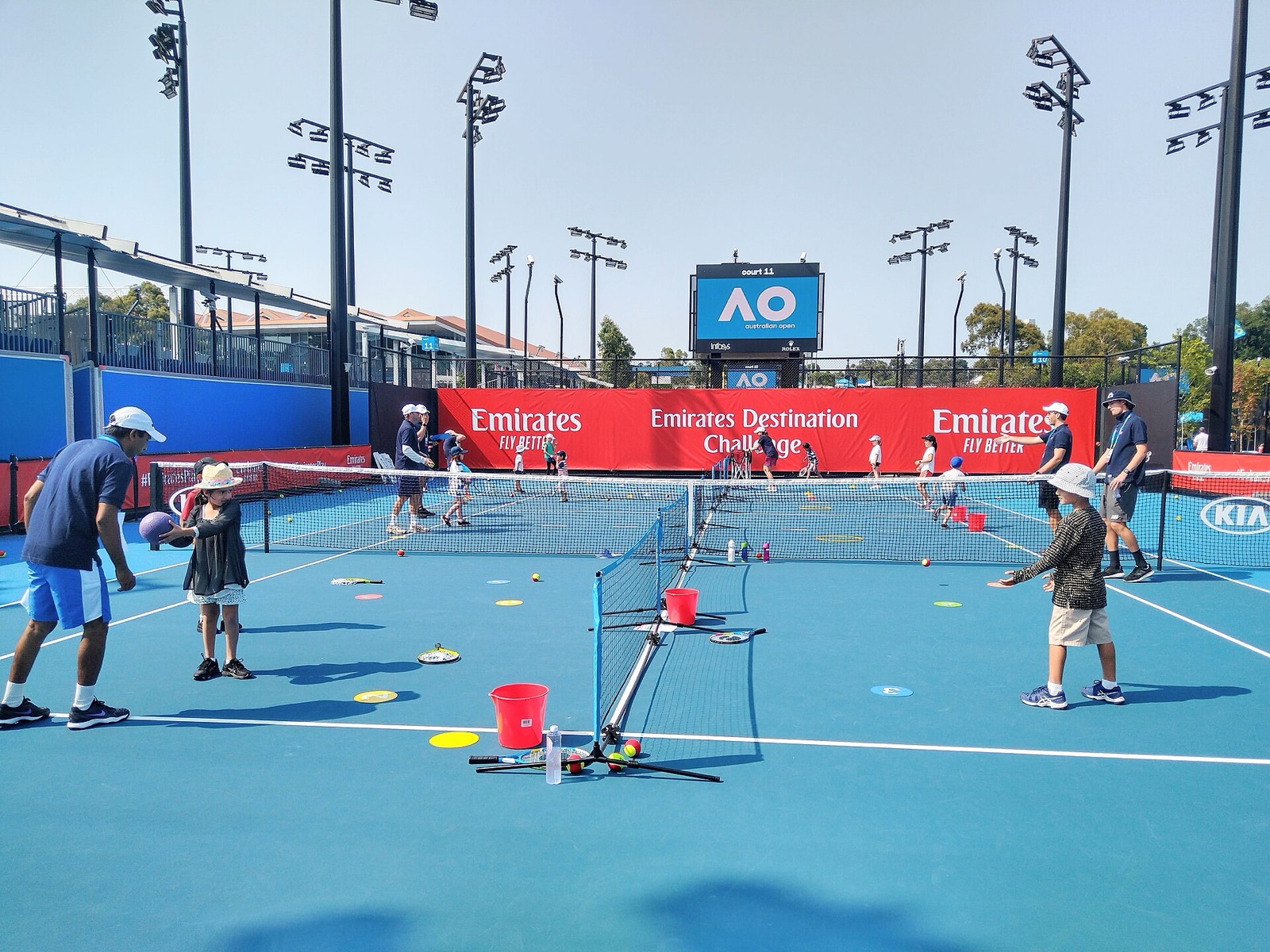

Start With Three Jobs, Not A Long List
A useful beginner drill should make one job obvious. This routine moves from keeping the ball on the racket, to choosing a target after the bounce, to returning one feed and recovering. Run the blocks in order the first time; use the chooser below when one part keeps breaking down.
Match The Ball To The Player
Use a slower ball the child can control. The ITF's starter pathway uses red, orange, and green balls with suitable court sizes for young players, while the LTA describes its age and racket chart as a starting guide. For informal practice, control matters more than rushing to a faster ball.
Run This 12-Minute Beginner Tennis Routine
Keep one ball in play at a time and reset after every attempt. The goal is a repeatable contact and recovery, not a continuous rally or a hard shot.
Set up before the first ball
Mark a dry, level rectangle about six adult paces long and four paces wide. Put two wide target gates at the far end, one to the left and one to the right, and a centre marker behind the child's starting spot. Use one racket and one red or other low-compression ball suited to the player's control. Keep everyone else at least one racket length plus an adult step outside the swing area.
Run the routine
Racket-face roll and freeze
Hold the racket face level in front with both feet balanced. Place the ball near the racket throat, roll it slowly toward the tip, then tilt the face back and stop the ball near the centre. Freeze for two seconds. Complete five controlled rolls in each direction; if the ball falls twice, shorten the roll rather than gripping harder.
Roll the ball slowly across the level strings, stop it near the centre, and freeze. The contact circle marks the usable racket-face area; both feet stay balanced.
Drop, bounce, and choose a gate
Stand three adult paces from the two wide gates. The child drops the ball slightly in front of the racket side. After the bounce, the adult calls left or right. The child uses a short swing to send the ball toward that gate, then resets. Count six contacts that stay inside the practice rectangle; the gate is a direction cue, not a pass mark.
After the ball bounces, call one of the two wide gates. The child uses a short swing from the marked contact area and sends the ball toward that gate.
Return, recover, and wait
The adult gives one gentle underarm feed to bounce in front of the child. The child returns it at a catchable pace, then moves behind the centre marker before the adult feeds again. The adult catches after one bounce and pauses until the child is set. Aim for three returns that the adult can catch without chasing.
The adult gives one gentle underarm feed. After a controlled return, the child moves behind the centre marker before the next ball is fed.
What success looks like
- The child can stop the rolling ball near the middle of the racket face without stepping after it.
- The self-feed bounces in front of the racket side and the send stays inside the marked rectangle.
- After a return, the child reaches the centre marker and balances before the next feed.
Make it easier
Use a foam or red ball, widen both gates, and let the adult name the gate before the drop. In the return block, move closer and feed to the same side every time. If racket control disappears, return to balancing the ball for three seconds.
Make it harder
Change one demand only: call the gate later, narrow the gates by one marker width, or ask for two catchable returns before a rest. Keep the slower ball until the child can prepare, contact, and recover without rushing.
Safety check
Clear loose balls before each block and stop the next feed until the child is behind the marker and looking forward. Check for water, gravel, toys, glass, roads, parked cars, and occupied paths. Nobody should wait beside or behind the swing. Stop if the child reports pain, dizziness, or cannot control the racket safely.
Choose The Drill By What You See
| What keeps happening | Start with | Change first |
|---|---|---|
| The ball rolls off before any swing | Racket-face roll and freeze | Shorten the roll and keep the strings level. |
| The child drops the ball behind the feet | Drop, bounce, and choose a gate | Drop from lower down and slightly in front of the racket side. |
| The shot flies beyond both gates | Drop, bounce, and choose a gate | Move closer and use a shorter swing with the same slower ball. |
| The child watches the shot and stays still | Return, recover, and wait | Pause the feed until both feet are behind the centre marker. |
| The adult has to chase every return | Return, recover, and wait | Feed more gently and ask for a catchable return rather than a winner. |
Use A Reset Between Repetitions
One ball is enough. A deliberate reset gives the child time to find the starting position, lets the adult clear the hitting area, and stops a missed shot from turning into a hurried chase. Feed again only when both people are ready.
Progress The Decision Before The Speed
When the contact becomes reliable, make the child choose between two wide targets or recover to one marker. Those changes connect technique to the next action without making the feed faster. Add pace only when the ball still arrives in a usable contact area.
What This Page Does Not Try To Teach
This routine is not a complete forehand lesson, serve lesson, or match plan. It gives a beginner controlled contacts and a simple recovery habit. A qualified local coach can assess grip, racket fit, movement, and technique in person.
Key pages
Tennis
Tennis for kids and beginners works best when the ball is slow enough to control. Use one racket, a small marked space, and this first session before attempting a full-court rally.
Tennis Ball Control Drills for Beginners: 10-Minute Plan
These beginner tennis ball control drills teach a child to steady the racket face, make one small tap, and send a self-fed ball toward a wide gate. Run the complete 10-minute routine with one racket and one slower ball.
Drop-Feed Forehand Drill for Kids: Contact in Front
This drop-feed forehand drill for kids gives the player control of the start. They drop a slower ball on the forehand side, meet it in front, send it through a wide gate, and recover before the next repetition.
Beginner Tennis Wall Rally Drill: Build Consistency
This beginner tennis wall rally drill turns the wall into a predictable practice partner. A child starts with one send and catch, adds a return after one bounce, then builds a short cooperative rally without chasing pace.
Beginner Tennis Serve-Toss Drill: Place and Balance
This beginner tennis serve-toss drill helps a child place the ball above head height and slightly in front, hold a balanced starting shape, and reset before adding a gentle serve.
Start Tennis at Home Without a Court
A child can begin tennis without a booked court, but the practice still needs a clear racket zone, a controllable ball, and one job at a time. This guide helps a parent choose the setup and run a flexible first routine.
Cameron Vale
Cameron Vale writes tennis activities that connect balance, movement, contact, and recovery without asking beginners to cover a full court too soon.
Sports
Choose a sport and start with drills, short sessions, and practice advice matched to the child in front of you.
Editorial Policy
How DrillsPedia researches, writes, checks, updates, and labels drills, sessions, videos, and parent guidance.
Common questions
What is the easiest tennis drill for a child beginner?
Start by balancing and slowly rolling a suitable slower ball on a level racket face. It removes the bounce and target while the child learns how small racket-angle changes move the ball.
Which tennis ball should a child use for these drills?
Use a slower ball the child can control. ITF Tennis10s uses red, orange, and green stages for players aged 10 and under, and the LTA publishes age-based starting guidance. For informal beginner practice, move to a faster ball only when preparation and contact remain controlled.
Can these tennis drills be done without a net?
Yes. Use marker gates and a tape line in a clear area. The child can practise racket-face control, a self-fed send, and a cooperative return without a regulation net or full court.
How long should a child practise beginner tennis drills?
This page uses 12 minutes split across three jobs. Stop earlier when safe racket control or attention disappears; a shorter controlled round is more useful than finishing the clock with hurried repetitions.