
Why The Toss Deserves Its Own Practice
A serve can unravel before the racket starts moving. If the ball drifts behind the child, too far sideways, or into a hurried reach, the swing has to chase it. That often looks like a serving problem when the first problem was simply where the ball went. Separating the toss gives a beginner time to learn one repeatable start without also worrying about power, the net, and a service box.
Balance Matters More Than A Perfect Height
Children often try to copy the tallest toss they have seen. A useful beginner toss is not the highest one. It rises above head height, sits slightly in front, and leaves the player able to reach comfortably without stepping after it. The LTA describes placing the ball above the head and slightly in front. This drill turns that broad picture into something an adult can see: a quiet start, a manageable ball path, and feet that stay organised.
Careful Supervision Keeps Repetition Useful
Repeated overhead work needs space and patience. An adult should check for low ceilings, branches, lights, fences, people, loose balls, and anything else inside the racket path. Keep one active ball, ask the child to let poor tosses fall, and give one cue between turns. A missed target is information, not a reason to demand ten faster attempts. Stop when the shoulder, elbow, or wrist hurts, or when frustration turns every repetition into a throw.
This Is A Placement Drill, Not A Power Lesson
The child does not need to hit a full serve to complete the practice. The first job is placing the ball and staying balanced. The racket is added as a reference for the overhead reach, then a gentle serve becomes an optional next step. The ITF Play and Stay programme supports slower balls and adapted conditions for starter players, so use equipment and distance that keep the action controlled rather than rushing toward an adult serve.
Run The Place, Reach, And Reset Routine
Use one active ball. The short version uses the first two blocks, the standard version uses all three, and the extended version adds a few gentle serves from a shortened distance only after the toss remains controlled.
Set up before the first ball
Choose a dry, level space with a full racket length plus an adult step clear on every side and generous clearance overhead. Mark a sideways starting line and place one flat landing marker slightly in front of the child's leading foot. Add a second marker behind the line for the reset. Use a suitable racket and one slower ball. No net is needed for the toss-only routine.
Run the routine
Stand sideways and place the ball
Start sideways behind the line with both feet still. Hold the ball in the non-racket hand. Lift and place it directly upward so it rises above head height and drops near the front marker. Let it bounce instead of reaching to catch it. Make five tosses that land within one adult step of the marker before adding the racket.
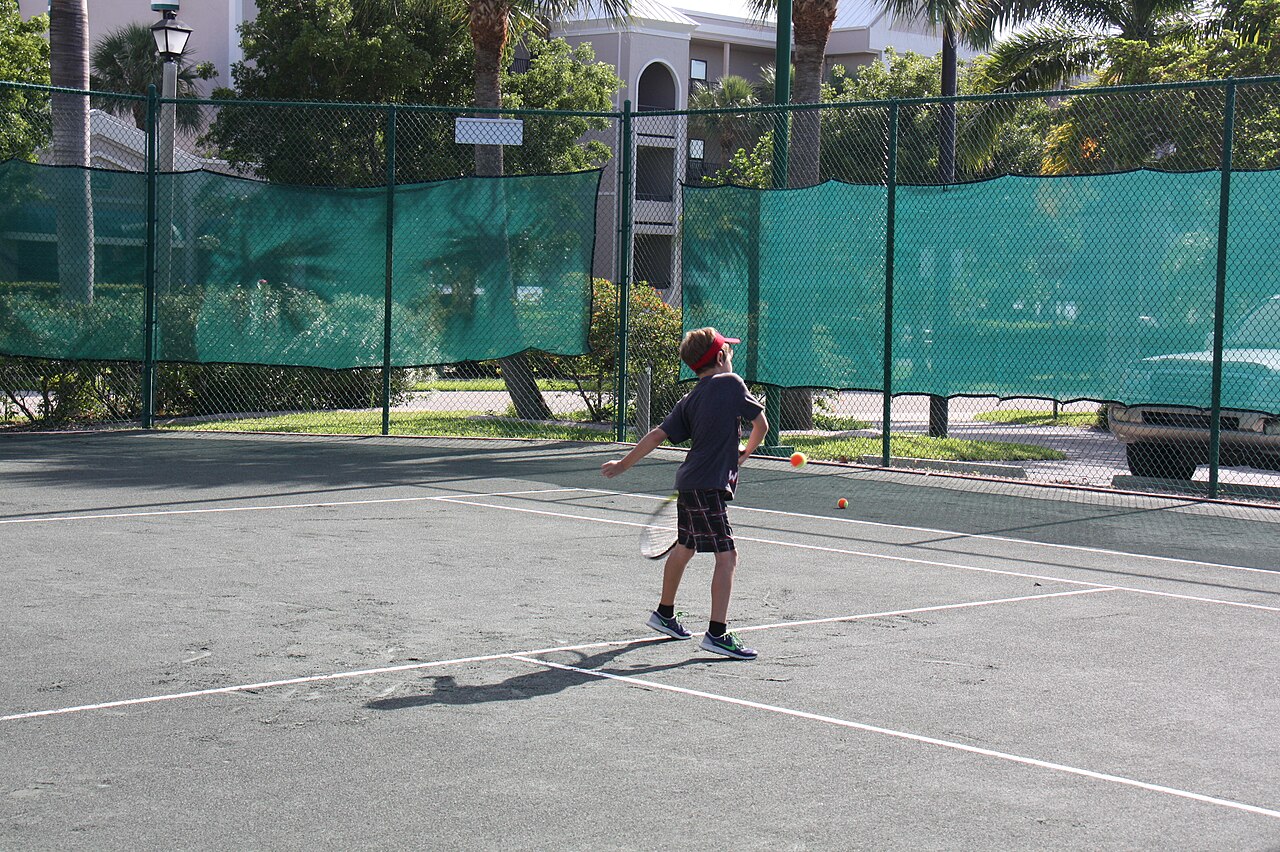
Stand sideways with both feet organised. Place the ball above head height and slightly in front, then let it fall toward the marker instead of chasing it.
Toss, reach, and let it fall
Hold the racket in the hitting hand and begin from a comfortable throwing shape. Place the ball upward with the free hand. Reach the racket to a comfortable overhead contact area without swinging at the ball, then let the ball fall and bounce. Freeze for one second. Count four repetitions where the child can reach without leaning, chasing, or crossing the line.
Reach the racket toward a comfortable overhead contact area but do not hit the ball. Let it fall while both feet remain visible and balanced behind the line.
Place, balance, and reset
Repeat the toss and overhead reach. After the ball bounces, return both feet behind the starting line and bring the racket back in front before collecting it. Alternate two tosses from the right side with two from the left side of the centre mark. The adult calls 'ready' only when the space is clear and the player is balanced.
After the toss and balanced reach, return behind the reset marker before collecting the ball. The racket, ball path, contact area, and both feet stay visible.
What success looks like
- The ball rises above head height and comes down slightly in front rather than behind the player.
- The child can reach toward the contact area without stepping across the line or leaning sideways.
- Both feet stay organised through the toss, and the player returns behind the line before collecting the ball.
- A poor toss is allowed to fall without a rushed swing or a chase into another person's space.
Make it easier
Put the racket down, use a foam or red ball, and lower the task to lift, bounce, and collect. Widen the landing area to two joined markers. A child who still throws the ball sideways can begin by placing it up from a bent elbow and letting it fall without any overhead reach.
Make it harder
Keep the same toss and add one demand only. Narrow the landing area, hold the balanced reach for two seconds, or use a shortened court to hit three gentle serves after several controlled tosses. Do not add height, speed, full distance, and a small target in the same round.
Safety check
Check the full overhead racket path before every block. Keep other people, pets, windows, vehicles, low ceilings, branches, and loose equipment outside the practice area. Use one active ball and collect it only after the racket is still. Stop for pain, dizziness, distress, or repeated loss of racket control.
Adjust The Toss From What You See
| What happens | Likely first issue | Change one thing |
|---|---|---|
| The ball lands behind the child | The release travels backward | Move the landing marker slightly forward and practise without the racket. |
| The ball travels far to one side | The hand is throwing across the body | Start with the free hand pointing toward the intended ball path and place straight up. |
| The child steps or bends to reach | The toss is outside a comfortable contact area | Let it fall, reset, and use a lower, closer toss on the next turn. |
| The ball spins sharply | The fingers or wrist are flicking at release | Use a quieter hand and place the ball from an open palm without chasing a spin-free result. |
| The next attempt starts immediately | The reset has disappeared | Require both feet and the racket behind the line before the adult says 'ready'. |
Choose A Short, Standard, Or Extended Version
For a short practice, complete the placement block and the reach block, then stop. The standard version uses all three blocks once. For an extended version, keep the same slower ball and add three gentle serves from a shortened distance only when the child can toss, reach, and reset without chasing. More repetitions are useful only while the movement stays calm.
What To Say After A Miss
Use a cue the child can act on: 'let that one fall', 'place it a little more in front', or 'reset both feet'. Avoid asking for a better serve when no serve is being hit. The drill is successful when the child notices an unusable toss and starts again, because that decision protects balance and gives the next action a fair chance.
Move Toward A Gentle Serve Gradually
The LTA beginner sequence starts sideways, places the ball above the head and slightly in front, then uses an overarm throwing action toward the target. Add that swing only after the toss lands in a comfortable area. Begin from a shortened distance with a large target and a slower ball. If the child starts chasing the toss again, return to the no-hit block.
Where This Drill Fits
Use the ball-control page first when the child is still learning to steady the racket face and manage one ball. Use the drop-feed forehand for a groundstroke contact in front. This page stays with the serve start: ball placement, overhead reach, balance, and reset. The broader tennis drill library can help choose the next problem once that start is repeatable.
Key pages
Tennis
Tennis for kids and beginners works best when the ball is slow enough to control. Use one racket, a small marked space, and this first session before attempting a full-court rally.
Tennis Drills for Kids: A 12-Minute Starter Routine
Use these tennis drills for kids to build racket control, direct a self-fed ball, and recover after a return. The 12-minute routine needs one racket, one slower ball, an adult feeder, and a small marked space.
Tennis Ball Control Drills for Beginners: 10-Minute Plan
These beginner tennis ball control drills teach a child to steady the racket face, make one small tap, and send a self-fed ball toward a wide gate. Run the complete 10-minute routine with one racket and one slower ball.
Drop-Feed Forehand Drill for Kids: Contact in Front
This drop-feed forehand drill for kids gives the player control of the start. They drop a slower ball on the forehand side, meet it in front, send it through a wide gate, and recover before the next repetition.
Riley Mercer
Riley Mercer writes beginner tennis pages that help parents and volunteer leaders turn one racket, a slower ball, and a small clear space into a usable first practice.
Editorial Policy
How DrillsPedia researches, writes, checks, updates, and labels drills, sessions, videos, and parent guidance.
Common questions
Where should a beginner's tennis serve toss land?
For this drill, aim for the ball to come down slightly in front and a little toward the hitting side, close enough for a comfortable overhead reach. The LTA uses a one-o'clock reference for a right-handed beginner; mirror that picture for a left-handed player.
How high should a child toss the ball for a tennis serve?
The ball should rise above head height and leave room for a comfortable reach. There is no useful fixed height for every child. A lower controlled toss is better than a very high one that forces waiting, leaning, or chasing.
Should a beginner catch a bad serve toss?
In practice, the safest choice is often to let it fall, step away from the racket path, and reset. The 2026 ITF Rules of Tennis also allow a server who decides not to hit a toss to catch it with the hand or racket or let it bounce without a fault.
Can a child practise the serve toss without a court?
Yes. Use a dry, level area with generous overhead clearance and enough room for the racket on every side. The toss-only blocks need a line and landing marker, not a net or full court.
When should a child start hitting a serve after this drill?
Add a gentle serve when the child can place several tosses in a comfortable area, reach without losing balance, and reset before the next ball. Start closer to a large target with a slower ball rather than asking for full-court power.