
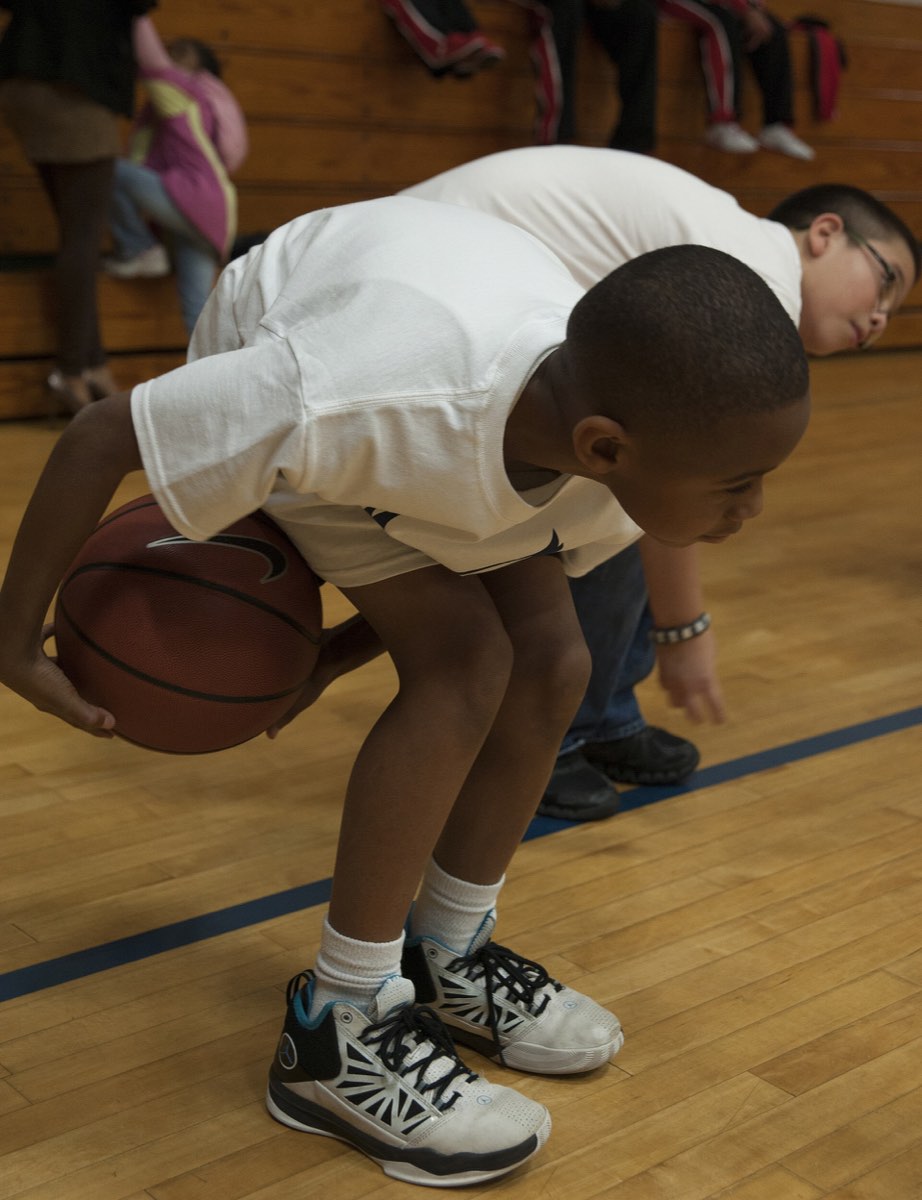

Keep both feet visible as the child walks the lane. The ball stays outside the near foot and beside the body.
Check the start and finish
The walking diagram above shows the lane. These two views show where the ball begins and how the repetition ends under control.
Before walking, make five bounces outside the left shoe. Keep both feet visible and still, then gather the ball with two hands.
Gather the ball before the final step, place both feet inside the box, and hold the balanced finish for two seconds.
Setup
Mark a straight lane about four metres long and one and a half metres wide. Put one flat marker at each end and add a one-metre stop box beyond the finish marker with chalk or removable tape. The child starts just inside the lane with the ball beside the left hip. Clear enough space beyond both ends to recover a loose ball without reaching traffic, steps, walls, spectators, or another practice group.
What This Drill Trains
The task joins two actions that beginners often separate: walking and bouncing with the less familiar hand. The first goal is not speed or a trick move. It is keeping the ball outside the left foot, taking slow steps, and arriving at the stop box in balance. The left-hand hub covers a wider practice menu; this page teaches one moving dribble in detail.
Use The Right Ball Before Correcting The Hand
A ball that is difficult for the child to grip can make every bounce look like a hand-position problem. USA Basketball recommends smaller balls for younger age groups because hand size and developing skill affect control. Use the age-appropriate ball already available at the session, then shorten the lane if the bounce still pulls the child sideways.
Keep The Ball Beside The Left Foot
Ask the child to bounce just outside the left shoe rather than between the feet. The fingers guide the top and outer side of the ball while the palm stays off it. The right arm can remain relaxed in front of the body as a protective shape, but this solo version does not need contact or an active defender.
Add Eyes-Up Checks Gradually
Jr. NBA guidance works toward dribbling without watching the ball, but a beginner does not need to stare forward for the whole lane on the first attempt. Start with one quick look at a parent's raised fingers after the second bounce. If the ball escapes twice in a row, remove the signal and restore it after one controlled walk.
Stop The Rep Before Speed Changes The Drill
Walking pace is the constraint that makes the hand movement visible. If the child begins running, crossing the ball in front, or chasing it beyond the lane, reset at the start. A clean repetition finishes with the ball gathered in two hands and both feet quiet inside the stop box. Speed belongs in a later progression, not in the first successful round.
Steps
- Minutes 0-1: stand at the start marker with knees softly bent. Make five left-hand bounces beside the left shoe, catch the ball with two hands, and repeat three calm times.
- Minutes 1-3: walk to the far marker using only the left hand. Take one slow step for each bounce and gather the ball before entering the stop box.
- Walk back down the same lane with the ball still outside the left foot. Rest for one breath after each length instead of rushing the turn.
- Minutes 3-5: a parent holds up one to three fingers after the second bounce. The child gives one quick answer, returns the eyes to the lane, and finishes the walk.
- Minutes 5-7: finish each length by gathering the ball in two hands and stopping with both feet inside the marked box. Hold the balanced position for two seconds.
- If the ball crosses in front of the feet or leaves the lane, restart from the nearest marker. Do not add a penalty lap or a faster replacement repetition.
- Minute 7-8: complete two final lengths at the easiest version that stayed controlled today. Finish with the better of the two rather than extending the session until a mistake appears.
Coaching points
- Say 'left shoe, left hand' if the ball drifts across the body. One short location cue is easier to use while moving than a list of hand instructions.
- Keep the steps small enough that the child never has to lunge after the next bounce.
- Use the fingers and fingertips to guide the ball; avoid slapping down with a stiff palm.
- Let the bounce stay below the waist while the child is learning the moving rhythm.
- Ask for one quick look up, then let the eyes return to the lane. Add another look only after the ball remains controlled.
- At the finish, watch the feet and ball together: two quiet feet in the box and a two-hand gather show that the repetition has ended under control.
Common mistakes
- The child runs through the lane. Shorten the lane and return to one step per bounce before asking for another eyes-up check.
- The ball crosses in front of both shoes. Move it back outside the left foot and repeat one stationary set before walking again.
- The bounce climbs above the waist. Ask for a softer push and lower starting hand rather than telling the child to crouch as low as possible.
- The child watches the parent for several steps and loses the ball. Show the signal for one second, then lower the hand so attention can return to the dribble.
- The adult counts only completed lengths. Also notice whether the ball stayed left, the steps stayed slow, and the stop finished in balance.
Make it easier
Stay at the start marker for five stationary left-hand bounces, catch, and reset. When that is steady, use a two-metre lane and allow the child to look at the ball for the whole walk. Remove the finger signal and stop box until the bounce remains beside the left foot.
Make it harder
Keep the same walking pace and add one change only: show two finger signals during the lane, narrow the stop box slightly, or ask the child to walk back without a rest. Do not add a defender and speed at the same time. A guided defender belongs after the child can move, look, gather, and stop reliably.
How to know it is working
Count a repetition as controlled when the ball stays on the left side, the child can take at least one brief look away from it, and the finish uses a two-hand gather with both feet inside the box. Progress after three controlled lengths, not after one lucky run. If only the stationary version works today, that is the correct finishing level.
Safety
Use a dry, level surface and flat markers that will not roll under a shoe. Keep the run-off area clear at both ends. Do not use the lane beside traffic, stairs, glass, loose gravel, wet flooring, or another drill. Stop if the child is chasing the ball outside the marked space or if tired posture makes the dribble unpredictable.
Common questions
Why is the left-hand dribble so difficult?
The less-used hand usually has fewer familiar repetitions. Begin with a stationary bounce, then join one slow step to each contact. The goal of this drill is a repeatable moving rhythm, not making both hands look identical in one session.
How many minutes of weak-hand work is enough?
This routine uses eight minutes, but the moving work can stop earlier if control disappears. A shorter set that ends with the ball beside the left foot is more useful than extra rushed lengths.
Should a child look at the basketball while learning?
Yes, when needed. First establish where the ball should bounce, then add one brief look toward a simple signal. Gradually extend the eyes-up moments instead of demanding a full lane without looking on the first day.
Does this drill work for a right-handed child?
Yes. It is written for a player whose left hand is less comfortable. A left-dominant player can mirror the lane and use the right hand, while keeping the same stationary, walking, looking, and stopping progression.