
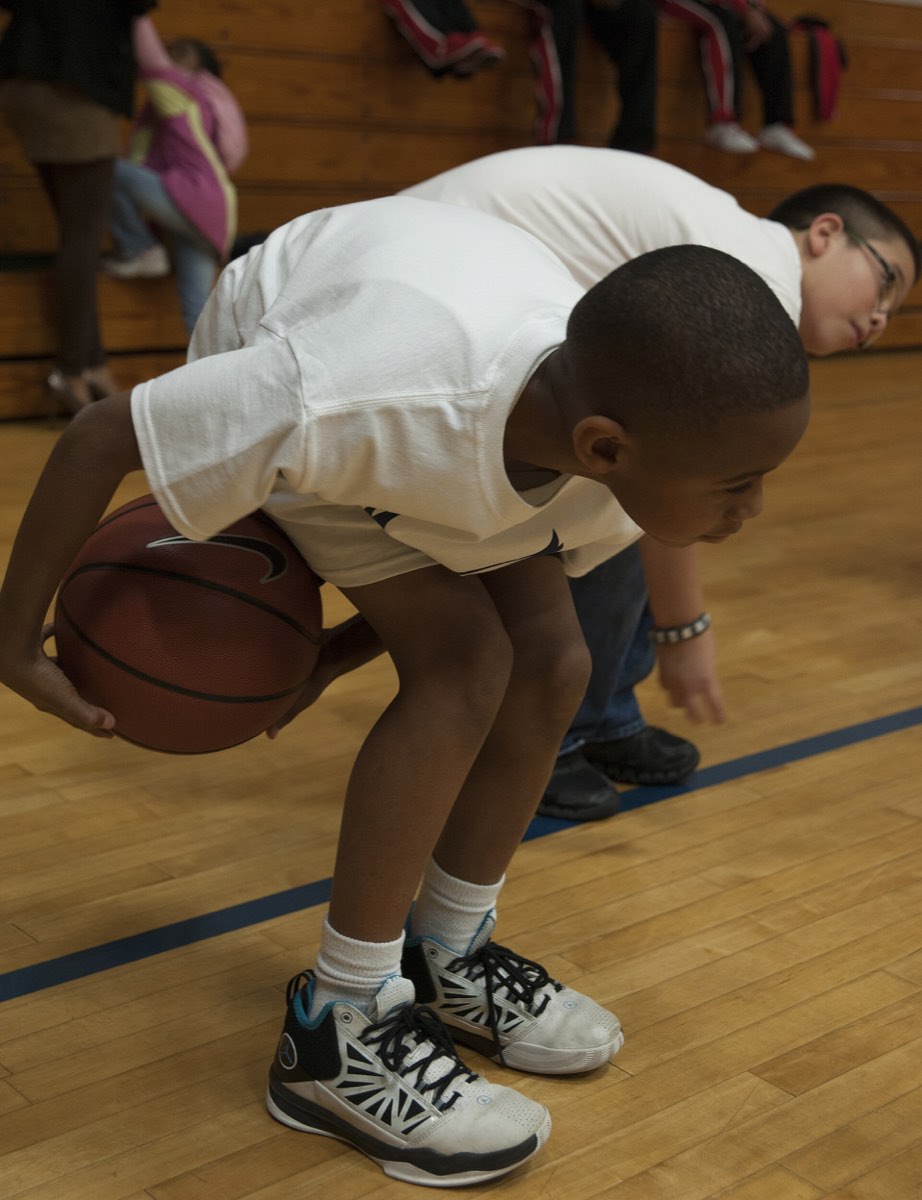

Before you start
Place one marker at the start and two more roughly 2 metres and 4 metres away. Leave a clear run-off area beyond the last marker. The child starts beside the first marker in a low stance, with the ball outside the weaker-side hip. For a left-handed child whose right hand is weaker, reverse every hand instruction on this page.
Session goals
- Return the ball to the weaker hand without chasing it across the feet.
- Walk slowly while keeping the dribble outside the weaker-side hip.
- Stop under control before the next instruction.
Run this 10-minute session
Build a repeatable stationary bounce before the feet start moving.
Keep both feet visible and planted just wider than the shoulders. Bounce beside one hip, then gather with two hands and freeze without shifting the feet.
Run it like this
- Use the first 30 seconds to set the stance: feet just wider than the shoulders, knees bent, chest up, ball outside the weaker-side hip.
- Make five waist-high bounces with the weaker hand, then catch the ball with two hands and freeze for two seconds.
- Repeat six short sets. Rest for one breath after each freeze instead of rushing straight back into the dribble.
- For the final minute, ask for one quick look at the far marker during each five-bounce set. Let the eyes return to the ball if control starts to go.
Coaching cues
- Use 'push, do not slap' if the palm lands flat on top of the ball.
- The ball should return beside the hip, not bounce across the toes.
- Count the two-hand freeze as part of the repetition; it shows whether the child is still balanced.
Keep the weaker-hand dribble controlled while the child walks the marked lane.
Keep both feet visible as the child walks the lane. The ball stays outside the near foot and beside the body.
Run it like this
- For two minutes, walk from the first marker to the middle marker using only the weaker hand. Stop, catch the ball, turn, and reset before walking back.
- If that short lane is controlled, use the far marker for the next minute. Keep the walk slow enough that the hand, ball, and feet share one rhythm.
- For the final minute, ask for one quick glance at the far marker during each trip.
- If the ball rolls away twice on one trip, return to the middle marker. Shorten the lane instead of telling the child to dribble faster.
Coaching cues
- Walk almost too slowly at first.
- Keep the ball outside the weaker-side foot rather than crossing it in front of the body.
- Ask for a quick glance, not permanent eyes-up dribbling before control is ready.
Add one simple decision without turning the finish into a sprint.
Call the middle or far marker. Keep both feet visible at the start, dribble outside the weaker-side foot, then slow down and stop inside the target box before tapping the marker.
Run it like this
- The adult calls 'middle' or 'far'. A solo player chooses the target before starting.
- Dribble to that marker with the weaker hand, stop the ball under control, and tap the marker with the free hand.
- Return to the start marker and finish with a two-hand catch and balanced freeze.
- Score one point only when the ball stays outside the feet and the final freeze needs no recovery step.
Coaching cues
- The call decides the distance, not the speed.
- Slow down before the marker instead of reaching for it while the ball escapes.
- Wait for a balanced freeze before giving the next call.
9:00-10:00 - Finish
Complete one calm sequence: five stationary weak-hand bounces, a walk to the middle marker, a two-hand catch, and a balanced freeze. Restart after a loose bounce. The target is one controlled sequence, not a speed record.
What success looks like
The session is working when the child can complete five stationary bounces and one short walk without the ball crossing the toes, then stop without taking an extra recovery step. Keep the lane short until that pattern is repeatable.
Make it easier
Keep all ten minutes at the start marker. Use three weak-hand bounces, a two-hand freeze, and one breath of rest. Add one walking step only after three clean stationary sets. A smaller, lighter age-appropriate ball can also make the first contacts easier to control.
Make it harder
Keep the same distances and add one decision: call 'middle' or 'far', ask for one quick eyes-up glance, or add a controlled change of direction before the freeze. Add only one change at a time.
Safety
Use a dry, level, non-slip surface and flat markers that will not catch a shoe. Clear people, cars, steps, and breakable objects from the lane and run-off area. Stop if the child reports pain, becomes dizzy, or repeatedly has to sprint after the ball.
Common questions
Should kids practise only the weak hand for ten minutes?
Yes, for this short block. Keep the task achievable and stop before frustration changes the stance or effort. Normal basketball practice should still use both hands.
Is left-hand practice the same as weak-hand practice?
Not always. Many right-handed players use the left hand as the weak hand, but left-handed players should reverse the instructions.
What if the child cannot walk and dribble with the weak hand yet?
Stay stationary. Use three bounces and a two-hand freeze, then add one step. The walking lane is a progression, not the starting requirement.
Does this session need a basketball court?
No. It needs a predictable bounce, a dry level surface, and a clear lane about 4 metres long. A hoop is not used.